
Insights
Developability Assessment, Formulation Screening, and Enabled Technologies to Advance Challenging Molecules Through Clinical Development
As part of our small molecule insights series, we review the essential aspects to assess developability and selection of the correct technology to support drug product development. A particular focus is applied to spray drying and some of the key benefits that can be gained using this process technology to enhance, solubility, bioavailability and it's suitability for scaling. The article was written by Fiona Kielthy Operations Director at Catalent's site in Nottingham (UK). This article aims to support outsourcers with considerations for technology and service provider selection.
The insights in this article come from Dr. Fiona Kielthy of Catalent Nottingham. With over 20 years' experience in API and drug product development, Fiona oversees the manufacture of early phase to niche commercial solid oral dosages at Catalent Nottingham.

Introduction
The development pipeline for modern small-molecule therapeutics increasingly features compounds with poor aqueous solubility, high lipophilicity, and complex solid-state behaviours. These characteristics can limit exposure, delay programme progression, or lead to attrition if not addressed early. An integrated approach to developability assessment, formulation screening, and material characterisation is therefore essential to ensure that viable formulation pathways are identified before clinical entry.
Enabled formulation technologies, particularly spray drying to produce amorphous solid dispersions (ASDs), play a critical role in supporting low-solubility molecules. When implemented early and strategically, these technologies can provide the performance, scalability, and stability required to advance compounds through Phase I and II clinical studies and onward towards commercialisation.
1. Developability Assessment: Building the Foundation
A strong developability strategy begins with predictive and experimental assessments to understand the molecule's intrinsic liabilities. Initially this involves using PBPK analysis - performed by Catalent's Science Advisory team - and performing a molecule developability assessment - to “define the problem statement before you formulate”. This stage informs viable formulation pathways and reduces downstream risk.
1.1 Key Physicochemical Parameters
Early characterisation typically includes:
- Kinetic and thermodynamic solubility mapping
- pKa and ionisation behaviour
- Lipophilicity (LogP/LogD)
- Solid-state characterisation (PXRD, DSC, TGA)
- Hygroscopicity and stability profiling
- Permeability estimates (PAMPA, Caco-2)
Identifying whether the compound is dissolution‑limited or solubility‑limited determines whether conventional approaches suffice or if enabling technologies are required.
1.2 Developability Risk Classification Systems
The Developability Classification System (DCS) is an adaptation of the Biopharmaceutical Classification System (BCS) designed for early formulation development, whereas the BCS is primarily a regulatory tool for predicting in vivo drug absorption. DCS improves upon BCS by using biorelevant media and lower dose thresholds to distinguish between dissolution-limited (IIa) and solubility-limited (IIb) drugs, facilitating faster development.
2. Pre-formulation and Formulation Screening
Once risks are defined, a structured formulation screening strategy is deployed to identify promising formulation approaches early. For DCS IIa or IIb molecules the following technologies may be used for screening:
- Particle size reduction
- Hot melt extrusion
- Lipids based formulations
- Spray Drying
Each pathway is assessed via solubility enhancement, dissolution performance, physical stability, and manufacturability.
3. Analytical Characterisation for Informed Decision-Making
Robust analytical techniques underpin formulation selection and process optimisation.
3.1 Key Analytical Tools
- PXRD for crystallinity and polymorphic changes
- Laser diffraction/PCS for particle size reduction
- DSC and mDSC for thermal events and miscibility
- FTIR/Raman for intermolecular interactions
- HPLC/UPLC for potency and impurity tracking
- Optical Microscopy/SEM for particle morphology, topography and qualitative size range
- In vitro dissolution profiling (biorelevant media) Microflux for permeability
- Accelerated stability to predict formulation robustness
3.2 Mechanistic Understanding
Analytical data helps:
- Confirm amorphous vs crystalline states
- Assess drug-polymer miscibility
- Predict physical stability of ASDs
- Understand degradation pathways under stress conditions
This ensures only viable formulations proceed to scale-up.
Spotlight - Spray Drying
As an example of enabling technologies, a closer look at spray drying follows.
Spray Drying: A Scalable Solution for Challenging Molecules
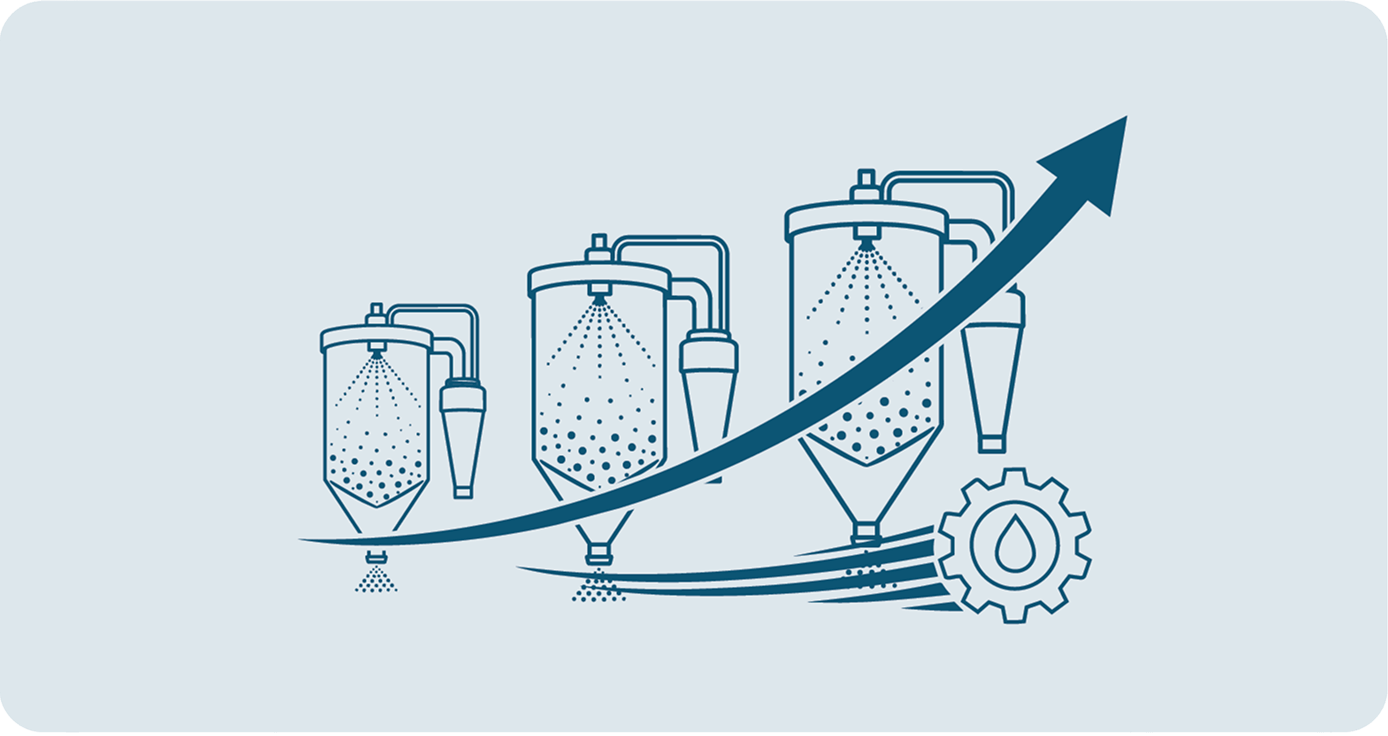
Spray drying is increasingly used to produce amorphous solid dispersions for low-solubility APIs. Its advantages include:
- High solubility enhancement via amorphisation
- Excellent control over particle morphology and size distribution
- Compatibility with a wide range of polymers and solvents
- Scalability from lab to commercial dryers
- Consistent performance enabling Phase I-III progression
Mechanism of Amorphous Solid Dispersions (ASDs)
ASDs stabilise APIs in the amorphous state using polymer matrices (e.g., PVP-VA, HPMCAS), improving:
- Apparent solubility
- Supersaturation maintenance
- Bioavailability
Development and Scale-Up Considerations
- Solvent selection and API solubility mapping
- Polymer selection and API-polymer miscibility
- Design of experiments (DoE) for robust process parameters
- Inlet/outlet temperature optimisation
- Residual solvent monitoring
- Physical stability assessment (PXRD, DSC)
A well-characterised spray-drying process accelerates transfer to GMP manufacturing.
Summary of Key Messages
- Early developability assessment is essential to identify API liabilities and guide formulation strategy before costly barriers arise later in development. Understanding the molecule’s liabilities first (using PBPK analysis) and conducting a molecule developability assessment form an essential part of a coherent drug development strategy.
- Comprehensive pre-formulation and formulation screening establishes a clear understanding of potential formulation pathways and de-risks progression into clinical phases.
- Advanced analytical characterisation supports informed decision-making by providing detailed insights into solid-state behaviour, stability, and in vitro performance.
- Spray drying and amorphous solid dispersions offer robust, scalable solutions for poorly soluble molecules, delivering substantial solubility enhancement and enabling clinical exposure.
- Spray-dried formulations are well-suited for clinical progression, supporting flexible early-phase batch sizes and providing a scalable, regulatory-accepted route to Phase II and beyond.
- Integrated application of developability, formulation screening, and enabled technologies accelerates timelines, reduces technical risk, and supports successful advancement of challenging molecules through clinical development.
- Robust spray-drying scale-up methodologies leveraging DoE-based process optimisation and thermodynamic modelling to ensure fully optimised, predictable scale-up from development through to clinical-scale manufacturing

Catalent's Nottingham facility focuses on early-stage development of small molecule drug candidates from the bench to clinic.
This facility offers an array of services that support oral dosage forms that include characterization, formulation and analytical development, manufacturing and clinical packaging, labelling and worldwide distribution. This MHRA approved facility includes cGMP dose form manufacturing, packaging, analytical and development laboratories with OEB 1-3 and controlled drug storage to handle even your most challenging products. Catalent Nottingham offer spray drying capabilities from early development to early phase GMP manufacture. Commercial spray drying is available as well for smaller scale requirements.