
Insights
How to author a robust analytical method for regulatory submission
Linda Cutler, a consultant at Regulink provides a short guide on how manufacturing site methods would typically be formatted and summarised for regulatory submissions.
Linda Cutler has worked in regulatory affairs for over 15 years and is a director and owner of her consulting company - PharmaVista which she set up in 2007. Linda supports Regulink on a range of consulting projects for a number of global clients.

Introduction
A robust analytical method for regulatory submission should aim to provide the detail required to satisfy the health authority thereby reducing requests for further information yet minimise superfluous information, which may later incur further regulatory submissions for change.
This article is part 1 of a 2 part series covering methods and validation and is a useful guide for any individual involved in authoring regulatory method and validation documentation or anyone interested in how regulatory documentation is approached from the initial site documents.
Key concepts
Some key concepts which are discussed within this article include:
- Referencing compendial methods, as applicable.
- Listing only key laboratory equipment and avoiding instrument makes and models, where possible.
- Including laboratory grades of material but avoiding material brands, where possible.
- Simplifying preparation steps for samples, reagents and standards.
- Only detailing critical instrument parameters.
- Including relevant System Suitability Tests.
- Clarifying calculations with equations where appropriate.
- Providing example chromatograms/spectra for samples, blanks and standards for applicable methods.
The purpose of this article is to provide some guidance on preparing common technical documents (CTD) for analytical methods (32S42, 32P42 and 32P52 sections) suitable for regulatory submissions to health authorities, in particular in the EU, UK, and US markets. Regulatory methods can generally be less detailed than the testing laboratory's method and this article provides some hints and tips on the acceptable level of detail typically required by these health authorities.
This article does not, however, endeavour to be a comprehensive guide to authoring analytical methods but aims to cover some areas which may help reduce the risk of questions and limit post approval changes.
The suggestions provided within this article have been previously used in regulatory submissions without further requests for information. However, there is no guarantee that a Health Authority will not request further information if they consider this necessary. In addition, this article is not intended to cover information provided in health authority guidelines and regulations, and these should be referred to when preparing any submission.
Cover Page
A cover page listing all analytical methods provided in the specifications section (32S41, 32P41 and 32P51 as applicable), with reference to compendial or in-house testing, and with crosslinking to each method provides a helpful overview for the reviewer. This could be provided in a tabular form. The table below provides an example of a few selected methods.
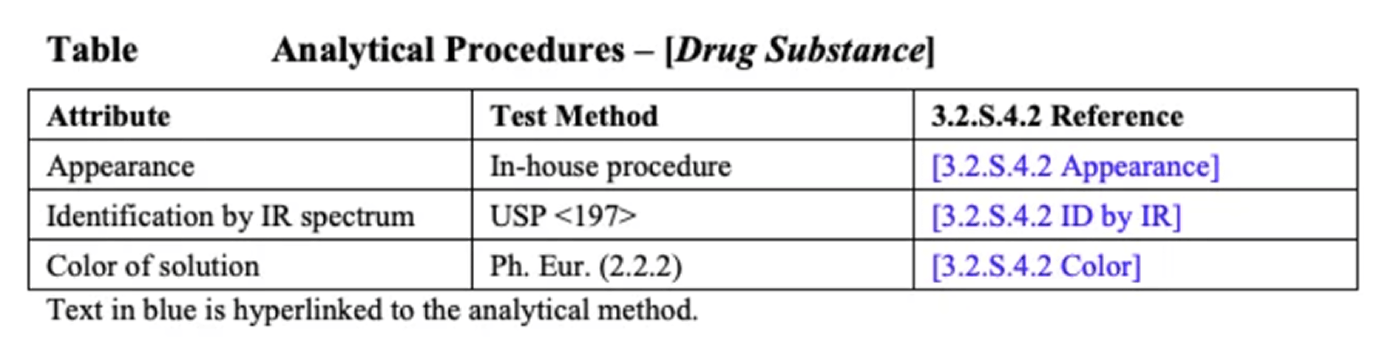
Where a method complies with a compendial method, it is generally acceptable to refer only to the compendia when submitting in the EU or UK. In addition, method validation is not usually required (except for microbiological testing methods). However, there is an expectation for US submissions that a brief summary, to include critical attributes, will be provided for compendial methods[i] together with method validation[ii] or at minimum method verification[iii].
[i] US FDA Analytical Procedures and Methods Validation for Drugs and Biologics
[ii] USP<1225> Validation of compendial Procedures
[iii] USP<1226> Verification of compendial Procedures
Analytical Methods Presentation
Sub-headings within the method together with a table of contents can aid review for lengthier methods. Sub-headings could include, as applicable:
1. Introduction
2. Apparatus
3. Reagents and Standards
4. Samples
5. Procedure
5.1 Reagents and Standards Preparation
5.2 Sample Preparation
5.3 Instrument Settings
5.4 System Suitability Tests
5.5 Test Procedure
6. Calculations
7. Reporting
8. Chromatograms
Information generally required for each of these sections is provided in the sub-sections below. Where there is excessive data (e.g. for novel or non-compendial excipients), additional data may be included in 3.2.A.3 Excipients section.
1. Introduction
The method introduction should include a brief description of what is being determined and how it is being tested together with the compendial reference if applicable, e.g. The water content of [drug substance] is determined by coulometric Karl Fischer titration and complies with USP<921> Water Determination.
For UK/EU markets, this statement should suffice for compendial methods. US submission will usually require a brief summary of the method to include any critical attributes.
2. Apparatus
The main apparatus should be listed but standard laboratory equipment such as weighing scales, flasks, pipettes do not need to be included. Typically, it is also not necessary to include makes and models of equipment unless this is critical to the method e.g. it is generally acceptable to state 'High Performance Liquid Chromatography (HPLC) system' without further detail. Where feasible HPLC columns can be described generically (without the need to specify make and model). Consider including 'or equivalent' after equipment to allow flexibility for like for like substitution, as might be required at a later date. This approach can reduce the need for unnecessary regulatory submissions for minor changes.
3. Reagents and Standards
Reagents and standards are best presented in a list and should include the analytical grade of each material e.g. Ph. Eur. grade. Quantities for each material generally need not be included and this allows flexibility to change quantities as needed, possibly without the requirement for a further regulatory submissions.
4. Samples
Samples may be listed without the need to specify the quantity required. This also allows flexibility to change quantities as needed, possibly without the requirement for further regulatory submissions.
5. Procedure
5.1 Reagents and Standards Preparation
Preparation of reagents and standards should generally be provided. These can sometimes be provided without the need to detail dilution steps, nor specific weights or volumes (see examples below). This allows flexibility to change weights and volumes as needed, without the requirement for a regulatory submission. e.g.:
- Prepare a blank solution of 50 mM ammonium acetate:acetonitrile, 30:70%v/v.
- Prepare a 1N NaCl solution.
- It is also generally not necessary to state the standard laboratory equipment used to prepare reagents and standards unless the equipment is critical to the method e.g. no need to refer to weighing bottles, flasks, pipettes.
5.2 Sample Preparation
The same level of detail used for reagents and standards can also be applied to the preparation of samples.
- Prepare a sample solution containing 10 mg/ml of [sample] in water.
5.3 Instrumental Settings
For more complex methods such as HPLC and gas chromatography (GC), it may be necessary to include equipment settings. These can be included in a tabulated form and typically should only include the critical parameters. Reference can also be made to these being 'example conditions' to allow flexibility to make non-critical adjustments as necessary.
5.4 System Suitability Tests (SST)
All critical system suitability tests should be briefly described in this section together with calculations where necessary.
5.5 Test Procedure
A brief description of the sample analysis can be included. This should only contain critical details. Where duplicate or multiple runs are performed, consideration should be given to whether this level or detail is necessary to include in the regulatory method. Not specifying this level of detail may avoid unnecessary regulatory changes at a later date, should the number of runs need to be amended. It may be enough to state, for example: 'Analyse the samples. Determine the concentration of [residual solvent] according to section 6 Calculations'.
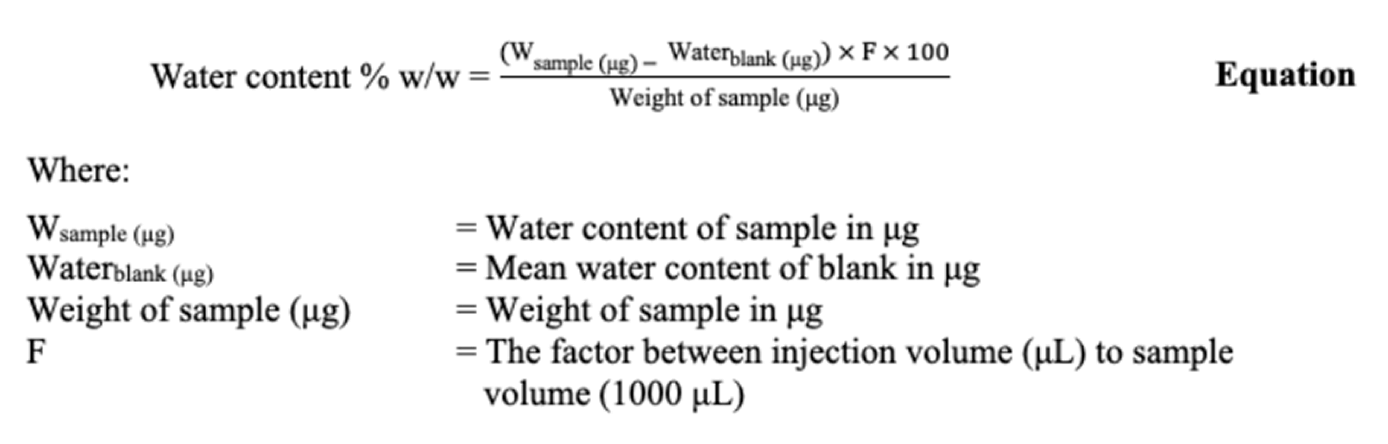
6. Calculations
Unless simple and obvious, calculations should be included. These should be clearly presented and state the units of measurement for each element within the calculation. An example is provided in the equation below.
7. Reporting
This section should detail how the results are reported, together with units of measurement and number of decimal places, as applicable. The reporting should align with the acceptance criteria presented in the specifications section. Where applicable, reporting may need to include reference to "ND" (not detected), "Fail", "NMT" (not more than) or "NLT" (Not Less Than) etc., as applicable to the acceptance criteria in the specifications.
8. Chromatograms
For methods where spectra and chromatograms are generated, it is prudent to include example chromatograms for each sample, standard, and blank. These should be legible, with axes and peaks clearly labelled.
Conclusion
A well authored analytical method offers both immediate and long-term advantages. A clearly presented method with the optimal level of information should decrease health authority review time and requests for information. Registration of this optimal level of information together with streamlined formatting across analytical methods will also reduce ongoing life-cycle management resource.

Peak Regulatory Resource - Quality / Efficiency / Value… when you need it
Regulink is a UK based specialist regulatory consultancy and was established in 2014 by veterans, Stuart Reed and Sunil Singh. They provide expert-led Regulatory Affairs solutions to the life sciences industry for the UK and Europe.