
Insights
Radiopharmaceutical Development: Key CMC and Regulatory Considerations for First-Time Sponsors. Paul Faulds. Regulink
Radiopharmaceuticals are becoming increasingly important in modern drug development, supporting precision diagnosis, patient selection, targeted therapy, and personalised treatment pathways. However, many pharmaceutical and biotech companies entering this field for the first time underestimate the unique CMC, regulatory, manufacturing, logistical, and radiation-safety challenges involved.
In this interview, we speak with Paul Faulds, a consultant at Regulink and a specialist in radiopharmaceutical CMC and regulatory strategy. Paul discusses the critical considerations sponsors should understand before initiating a radiopharmaceutical development programme.

1. What is driving the increasing focus on radiopharmaceuticals in modern drug development?
I think the renewed focus is being driven by the fact that radiopharmaceuticals can do something conventional medicines often cannot: they can combine very specific biological targeting with either imaging or targeted radiation delivery. In oncology, that has obvious appeal because it allows us to identify disease, select patients, understand where a target is expressed, and in some cases treat the tumour using the same overall biological principle. That theranostic concept is powerful, but it also means sponsors need to think about the product, the isotope, the patient pathway, and the manufacturing model as one connected development strategy rather than as separate workstreams.
2. For organisations with no prior experience, what are the key differences between developing a conventional pharmaceutical product and a radiopharmaceutical?
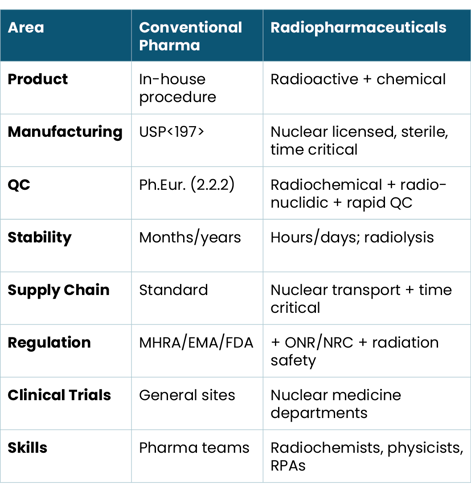
The biggest difference is that the product is changing while you are trying to manufacture, test, release, ship, and administer it. With a conventional medicine, stability is often measured in months or years. With a radiopharmaceutical, the useful life may be hours or days, and that has a major impact on every part of development. You also have to manage radiation protection, specialist facilities, rapid QC, licensed transport, and clinical sites that can handle radioactive material. One important practical point from my own experience is that testing is not simply a question of whether an analytical method exists. You also have to consider the radiation exposure to analysts, which can limit how much testing can reasonably and safely be performed.
3. How early should sponsors begin planning the CMC, manufacturing, and regulatory strategy for a radiopharmaceutical programme?
It needs to be planned from the very beginning. In my view, sponsors get into difficulty when they treat the radiopharmaceutical aspects as something that can be added later to an otherwise conventional development programme. The isotope choice, half-life, synthesis route, formulation, sterility strategy, release testing, site capability, and regulatory pathway are all interdependent. If those decisions are not joined up early, you can end up with a product that is scientifically attractive but operationally very difficult to manufacture, release, or deliver to patients within its usable shelf life.
4. How should sponsors decide whether they are developing a diagnostic, therapeutic, or theranostic radiopharmaceutical strategy?
That decision should start with the clinical question. Are you trying to image target expression, select patients, stage disease, monitor response, or deliver a therapeutic radiation dose? The same target may support a diagnostic, a therapeutic, or a theranostic approach, but the development requirements are not the same. The isotope characteristics, dosimetry, patient population, endpoints, and regulatory evidence package all need to fit the intended use. A theranostic strategy can be very compelling, but it needs to be designed deliberately rather than assumed because a diagnostic and therapeutic pair looks attractive scientifically.
5. What are the most common CMC challenges encountered during radiopharmaceutical development?
The common CMC challenges are usually very practical. Sponsors have to secure reliable isotope supply, develop robust radiochemistry, control radiochemical and radionuclidic purity, understand radiolysis, define specifications, and establish release methods that can be performed quickly enough to be meaningful. Sterility is another key issue because many products have to be released before the final sterility result is available. The other point I would emphasise is that the testing strategy has to be proportionate and realistic. Analyst exposure can place real limits on repeat testing, investigation work, and method execution, so the control strategy has to be designed around both product quality and radiation safety.
6. How do radioactive isotopes influence manufacturing strategy, supply chain design, and clinical trial logistics?
Radioactive half-life drives the manufacturing and supply chain model in a way that is very different from conventional pharmaceuticals. You have to work backwards from the patient administration time and consider synthesis, QC, QP or quality release, transport, receipt at site, and administration. There is very little room for delay. A point that is sometimes missed is that process validation batches are not commercially useful in the normal sense. Because the shelf life is imposed by radioactive decay, you cannot simply hold or repurpose those batches for commercial supply later. That affects cost, scheduling, validation planning, and the way sponsors think about launch readiness.
7. What specific regulatory expectations should sponsors be aware of when developing radiopharmaceuticals in Europe, the UK, or the United States?
Sponsors should expect the usual medicinal product requirements, but with additional interfaces around radioactive materials, radiation protection, transport, site capability, and in some cases nuclear licensing. The details differ between Europe, the UK, and the US, but the principle is the same: regulators will expect the sponsor to understand the quality attributes of the product and to show that the manufacturing, testing, handling, and administration model is controlled. Early regulatory engagement is very helpful because assumptions that may be reasonable for a conventional product do not always translate well to a radiopharmaceutical.

8. What additional considerations apply when preparing CMC sections for regulatory submissions involving radiopharmaceuticals?
The CMC sections need to tell a very clear story about control. That includes the isotope source, starting materials, synthesis and purification, formulation, specifications, release testing, stability, radioactive decay, impurities, container closure, and aseptic processing. For radiopharmaceuticals, the relationship between the control strategy and the practical release window is particularly important. It is not enough to list tests; the sponsor has to show that the tests can be completed safely, consistently, and quickly enough to support release and patient administration.
9. How do requirements differ between diagnostic radiopharmaceuticals and therapeutic radiopharmaceuticals?
For diagnostic products, the dose is generally lower and the focus is often on image quality, biodistribution, patient selection, and safety margins. For therapeutic products, the evidence burden is different because the product is intended to deliver a clinically meaningful radiation dose. Dosimetry, organ exposure, toxicity monitoring, efficacy endpoints, and patient management become much more prominent. Manufacturing can also be more demanding because therapeutic isotopes may involve different supply chains, higher activities, more complex handling, and tighter operational controls.
10. When planning radiopharmaceutical development, what are the key factors that determine whether manufacturing, QC, or regulatory work should be conducted in-house or outsourced?
The decision should be based on capability, not convenience. A sponsor may have excellent pharmaceutical development experience but still lack radiochemistry expertise, suitable facilities, radiation protection infrastructure, rapid QC capability, or access to isotope supply. Outsourcing can be the right answer, but it does not remove sponsor responsibility. The sponsor still needs to understand the critical risks, qualify the partner properly, define quality agreements clearly, and maintain enough internal knowledge to challenge assumptions and make informed decisions.
11. What capabilities should sponsors look for when selecting CROs, CMOs, radiochemistry providers, or specialist consultancy partners?
I would look for evidence that they have actually done this work before, not just that they understand it in theory. That means relevant licences, appropriate facilities, experienced radiochemists, rapid QC capability, GMP experience, qualified supply routes, established radiation protection arrangements, and a track record of supporting regulatory submissions or clinical supply. I would also want to understand how they manage deviations and delays, because in radiopharmaceuticals a small operational issue can quickly become a lost batch or a missed patient administration.
12. What are the most frequent mistakes made by first-time sponsors entering the radiopharmaceutical field?
The most frequent mistake is underestimating how integrated the whole system needs to be. Sponsors may choose an isotope late, assume QC can be expanded like a conventional analytical package, overlook analyst exposure, underestimate the site-readiness burden, or fail to appreciate how little flexibility there is once the batch is manufactured. Another common issue is assuming that process validation or engineering batches can be treated like conventional stock. With very short shelf lives, those batches have value for validation and learning, but they are not commercially usable in the way sponsors may be used to.
13. How can companies effectively manage timelines, costs, and regulatory risk when planning radiopharmaceutical programmes?
Good planning starts with identifying the true critical path. In radiopharmaceuticals that is often not just the clinical protocol or the manufacturing campaign; it may be isotope availability, validation scheduling, QC method readiness, transport arrangements, site permissions, or radiation-safety approvals. Sponsors should build realistic timelines, include contingency planning, and make sure CMC, clinical, regulatory, quality, logistics, and radiation-safety teams are working from the same plan. The cost of finding a problem late is high because there may be no shelf-life margin to recover from it.
14. Looking ahead, what developments in radiopharmaceutical science and regulation do you believe will have the greatest impact on future drug development programmes?
I expect the field to continue moving quickly, particularly around theranostics, alpha emitters such as actinium, supply-chain models, and decentralised or networked manufacturing. Regulation will also continue to evolve as more sponsors enter the space and as products move from specialist centres into broader clinical use. For me, the most important development is that radiopharmaceuticals are becoming more visible as medicines, not just as niche nuclear medicine products. That should bring investment and innovation, but it also means sponsors need to raise their level of operational and regulatory discipline.
15. If you could give one piece of advice to a sponsor considering its first radiopharmaceutical project, what would it be?
My advice would be to bring the right expertise in early and listen to it. Radiopharmaceutical development can look deceptively familiar to people with conventional pharmaceutical experience, but the combination of radioactive decay, patient scheduling, radiation safety, rapid testing, and specialist clinical delivery changes the whole development model. On a personal level, I also think it is worth remembering why this work matters. I knew a man in my neighbourhood, Sean*, who was taking part in an actinium-225 PMSA trial for advanced prostate cancer, and that brings home the human side of these programmes. These are not just interesting technical challenges; they are potential options for patients with very limited alternatives.
*name changed
"Radiopharmaceutical development can provide powerful diagnostic and therapeutic opportunities, but it requires a level of planning and specialist expertise beyond that typically encountered in conventional drug development. Early engagement with experienced CMC, regulatory, manufacturing, radiation-safety, and operational experts can help sponsors avoid costly delays while maximising the value generated from these highly specialised programmes."

Regulink is a UK based specialist regulatory consultancy and was established in 2014 by veterans, Stuart Reed and Sunil Singh. They provide expert-led Regulatory Affairs solutions to the life sciences industry for the UK and Europe.