
Insights
The significance of QP Services for Product Importation to support development programmes
In our consultancy insights interview series, we review the 'the significance of QP Services for Product Importation to support development programmes''. This interview aims to address the considerations necessary for UK-EU product flow. The interview aims to help pharma and biotech companies understand why QP support is necessary, what it involves, and what benefits can be achieved by involving QPs early in supply chain planning and execution.

Introduction
Mark Dignum is the Founder of Copea Pharma Ltd and Copea Pharma Europe and is a qualified QP. Mark has over 25 years of experience in both operational and quality focussed roles ranging from multi-national organisations to SME's in the UK. His breadth of experience helps to support clients not only with quality challenges associated with batch release but also with the alignment of the commercial challenges in meeting project milestones or supply chain commitments.
The role of the QP
1. What is a Qualified Person (QP),
and what is their legal
responsibility?
A Qualified Person (QP) is a statutory
role in the UK/EU responsible for
certifying each medicinal product batch
before release. They ensure compliance
with GMP, the Marketing Authorization,
and legal standards. QPs hold personal
legal accountability, including
potential criminal liability,
prioritizing patient safety over company
interests.
2. Why is a QP needed for product
importation into the EU (and export
from UK to EU)?
A QP is required to certify imported
medicines meet EU GMP and Marketing
Authorization standards. They ensure
products made outside the EU are
equivalent in quality and safety,
safeguarding patients. For UK-EU trade,
post-Brexit, QP oversight is mandatory
for regulatory compliance and legal
batch release.
3. How does the QP role differ
between the UK and the EU (if at
all)?
The QP role in the UK and EU is largely
the same: certifying batch compliance
with GMP and Marketing Authorizations.
Post-Brexit, however, the UK and EU
require separate QPs for product release
into their respective markets, meaning
dual certification may be necessary for
cross-border supply.
Considerations for Import and Export
4. Please can you explain how the
regulatory landscape has changed
since Brexit in terms of importing
and exporting medicines between the
UK and EU?
Since Brexit, the UK is a “third
country” to the EU. Medicines moving
between the UK and EU now require
additional regulatory steps: EU imports
need EU-based QP certification, while UK
imports need UK QP certification.
Separate Marketing Authorizations are
required for UK and EU markets. Mutual
recognition of QPs no longer applies,
meaning dual testing, certification, and
pharmacovigilance oversight may be
necessary. Northern Ireland follows the
EU regulatory framework under the
Windsor Framework, adding complexity.
Overall, Brexit introduced duplication,
extra costs, and administrative burdens
for medicine supply between the two
regions.
5. What are the practical
implications when performing
clinical trials where either a
comparator product or trial material
must cross borders for use?
When clinical trial materials or
comparators cross UK-EU borders, dual
regulatory requirements apply. Each
region requires local QP certification,
import licenses, and compliance with
GMP. This can cause delays, added costs,
and duplicate testing. Sponsors must
manage separate supply chains,
regulatory submissions, and
documentation. Northern Ireland
complicates logistics further.
6. What are the implications if a
company does not have QP oversight
in place when moving products
between the UK and EU?
Without QP oversight, products cannot be
legally certified or released for use in
the UK or EU. This means medicines may
be stopped at borders, leading to supply
chain disruption, trial delays,
regulatory non-compliance, and potential
product recalls. Companies risk
financial penalties, reputational
damage, and patient safety concerns.
7. What does the typical process
look like when a QP certifies a
batch for import into the EU? /What
documentation and information does a
QP typically need from a biotech
company?
For EU import, the QP reviews full batch
documentation, including the Batch
Manufacturing Record, Certificates of
Analysis, stability data, and GMP
compliance evidence from the
manufacturing site. They also need the
Marketing Authorization/CTA details,
supply chain traceability, and import
license. After verifying compliance with
EU GMP and regulatory requirements, the
QP certifies the batch for release.
8. How does the QP coordinate with
CMOs/CDMOs and logistics partners?
The QP liaises closely with CMOs/CDMOs
to review manufacturing, testing, and
quality documentation, ensuring
compliance with GMP and regulatory
requirements. They coordinate with
logistics partners to confirm supply
chain integrity, import/export licenses,
and temperature-controlled transport.
Effective communication ensures timely
documentation flow, issue resolution,
and compliant, secure product release
across borders.
The benefits of early QP oversight
9. Some companies traditionally try
to keep QPs at the end of the supply
chain. Can you share any examples
where the absence of early QP
support caused major delays or
issues with product release?
Delaying QP involvement can cause
significant setbacks. For example, some
biotech firms faced EU import refusals
because documentation from CMOs lacked
critical GMP evidence or Certificates of
Analysis. In another case, clinical
trial shipments were delayed weeks due
to missing QP certification and
unresolved deviations, halting patient
dosing. Early QP engagement helps
anticipate regulatory gaps, coordinate
batch testing, and streamline
cross-border logistics, preventing
costly delays and compliance risks.
10. At what stage in development or
commercialization do you think a
biotech company should engage with a
QP service provider when considering
their supply chain?
A biotech company should engage a QP
service provider early in development,
ideally during process scale-up or
before first clinical trial material
production. Early involvement ensures
GMP compliance, regulatory alignment,
and robust supply chain planning. It
allows proactive identification of
documentation, import/export, and
certification requirements, reducing
delays during clinical trials and
commercial launch, and ensuring smooth
cross-border product release.
11. What should biotech companies
look for when selecting a QP service
provider?
Biotech companies should seek QP
providers with proven GMP expertise, EU
and UK regulatory knowledge, and
experience across clinical and
commercial supply chains. Key factors
include a strong track record with
cross-border imports, robust
documentation review processes,
proactive regulatory guidance, and
effective coordination with CMOs/CDMOs.
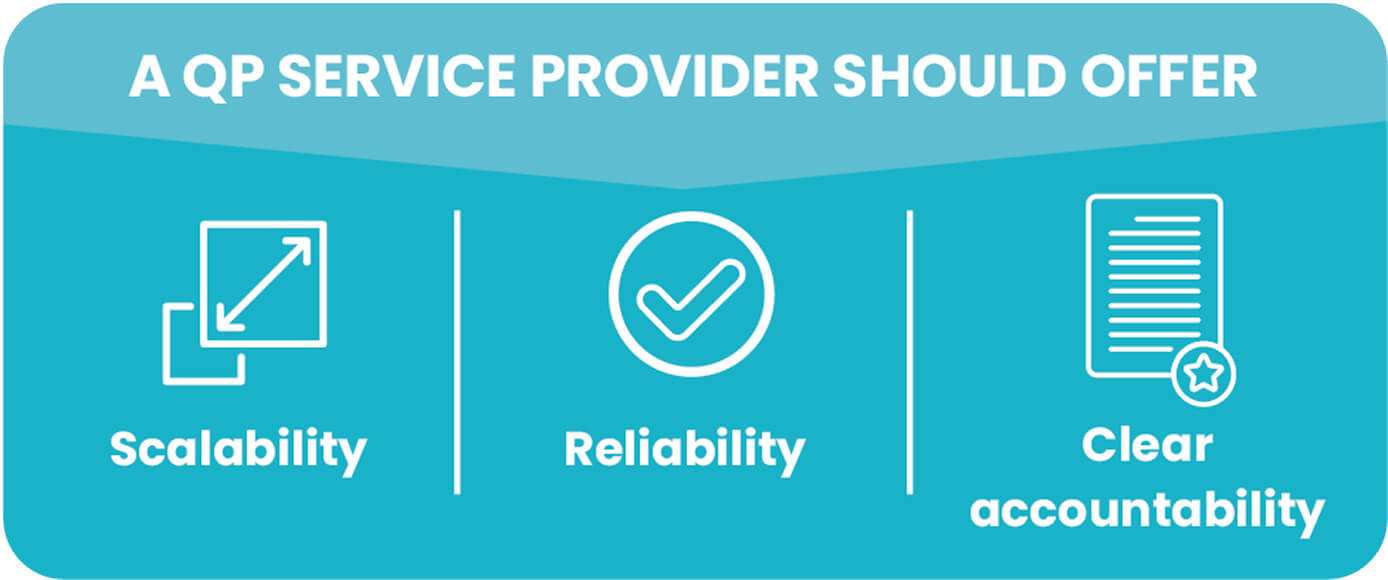
Providers should offer scalability,
reliability, and clear accountability,
with independent judgment and legal
responsibility for batch certification.
Familiarity with both early-stage trials
and commercial launch requirements
ensures seamless support throughout
product development.
12. What questions should a biotech
company ask a potential QP provider
before engaging them?
A biotech company should ask a potential
QP provider:
- Do you have experience with EU and UK GMP and regulatory requirements?
- Have you certified batches for both clinical trials and commercial products?
- How do you coordinate with CMOs/CDMOs and logistics partners?
- Can you manage cross-border imports/exports and dual-market releases?
- How do you handle deviations, inspections, or regulatory audits?
- What is your availability and turnaround time for batch certification?
- Can you provide references from similar biotech clients?
These questions ensure competence, reliability, and regulatory compliance.
Additional Strategic Benefits of QP Support
13. In addition to importation and
product release, what other value
can a QP bring to project/programme
delivery?
Beyond importation and batch release, a
QP adds value by providing regulatory
guidance, identifying potential
compliance risks early, and supporting
supply chain strategy. They help
optimize documentation, ensure
consistent GMP adherence, and streamline
audits and inspections. QPs can advise
on clinical trial material planning,
deviation management, and risk
mitigation, improving timelines and
reducing delays. Their oversight fosters
cross-functional coordination between
manufacturing, quality, and logistics
teams, ensuring smoother project
delivery, enhanced patient safety, and
confidence in regulatory compliance
throughout development and
commercialization.
14. What are the long-term benefits
of building a strong relationship
with a QP provider?
A strong QP relationship ensures
consistent regulatory compliance,
smoother batch releases, and reduced
risk of delays or recalls. Long-term
collaboration fosters deep understanding
of a company's processes, supply chain,
and product portfolio, enabling
proactive guidance and faster
problem-solving. It improves planning
for clinical and commercial supply,
supports audits and inspections, and
enhances overall quality culture.
Reliable QP oversight also strengthens
regulatory credibility and investor
confidence, while providing continuity
and efficiency as the company scales,
launches new products, or expands into
multiple markets.
Conclusion
15. If you had one piece of advice
for a biotech company planning to
move products between the UK and EU,
what would it be?
Engage a QP early in the planning
process—before manufacturing or clinical
trial material production. Early QP
involvement ensures compliance with both
UK and EU GMP, streamlines import/export
certification, anticipates regulatory
gaps, and coordinates supply chain
logistics. This proactive approach
minimizes delays, reduces risk of
non-compliance, and safeguards patient
safety, ultimately saving time, cost,
and resources while ensuring smooth
cross-border product movement.
Copea Pharma Ltd and Copea Pharma Europe are contract organisations specialising in independent QP services in the UK and Europe. The company holds licences for the wholesale, importation, and packaging of Investigational and Licensed Medicinal Products, as well as the importation and handling of "Specials" (unlicensed medicines supplied on a named-patient basis). Copea Pharma and Copea Pharma Europe also provide comparator and auxiliary medicine sourcing services.